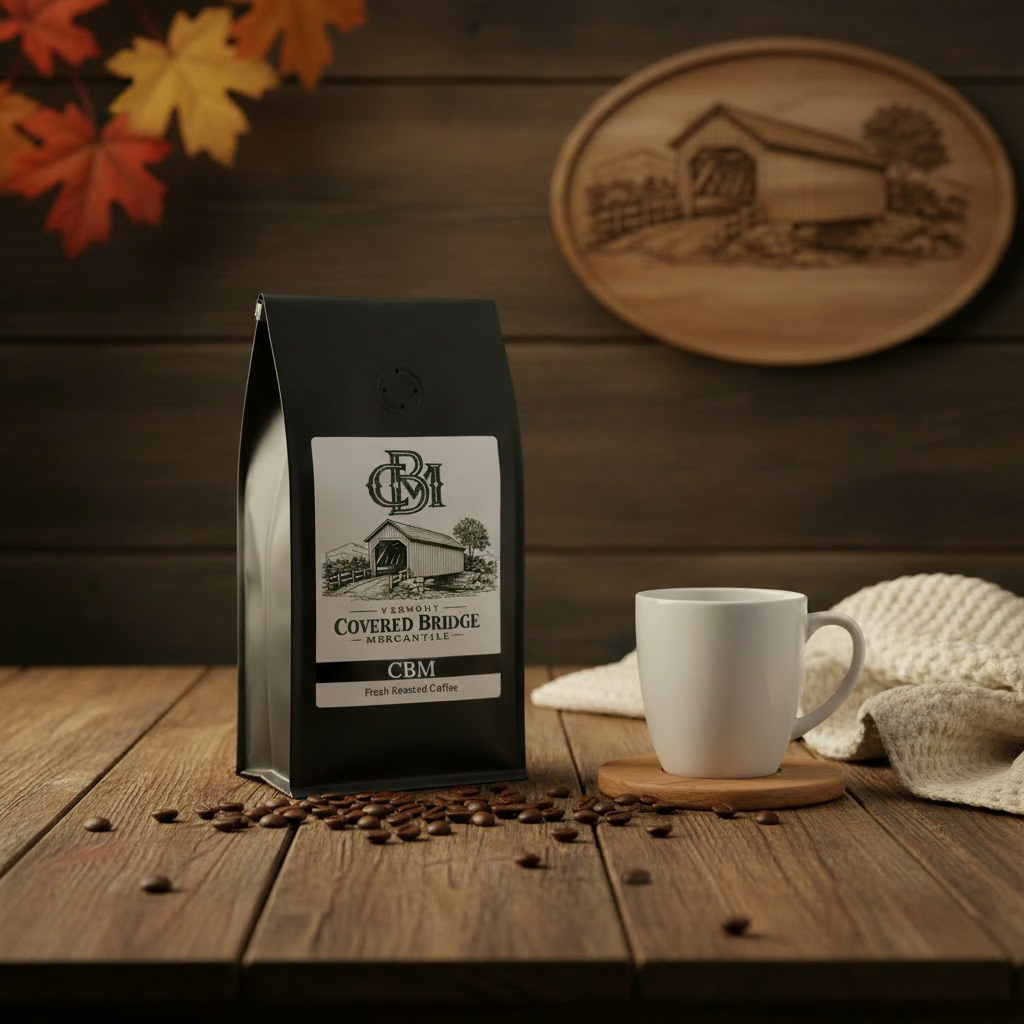
Covered Bridge Mercantile
Bali Blue
Bali Blue
Bali Blue Moon takes its name from the bean itself — the hallmark bluish hue that emerges from a processing method called Giling Basah, or wet-hulling. It’s a technique unique to Indonesia, and it shapes everything about this coffee’s character.
The bulk of Bali’s coffee comes from small family-owned farms in the volcanic highlands of Kintamani, where producers cultivate coffee alongside citrus trees on the slopes of Mount Agung. After harvest, cherries are carefully sorted, depulped, and fermented overnight in each farmer’s own micro-mill. The coffee is washed and laid on raised beds to shed moisture — then, while still at high moisture content, the parchment is removed and the bean is left exposed to finish drying. That’s Giling Basah. That’s the blue.
These farms are organized around a Subak Abian — a reference to the ecologically sustainable irrigation systems developed over 1,000 years ago by Hindu priests practicing Tri Hita Karana, a philosophy of harmony between the environment, humans, and God. Pesticides and synthetic fertilizers are never used. The land is tended the way it always has been.
Sourced from smallholder farmers in the Kintamani highlands, grown at 1,200–1,600 meters on volcanic loam soil, the Bourbon, Typica, and Catimor varieties are hand-picked and wet-hulled, yielding a medium-dark roast with notes of dark chocolate, molasses, and brown sugar — rich, earthy, and deeply satisfying.
Ancient methods. Exceptional coffee.
The full farm story is just below.
Couldn't load pickup availability
Share